Important Note: This Internet version of 7 News is a verbatum
transcript of our evening television news script. Many interviews on our newscast
are conducted in Creole. In the interest of clarity for our foreign readers,
we attempt to paraphrase the Creole quotes in English
Tonight, Belize's Co-Agent before the ICJ, Alexis Rosado, has been forced to resign. This comes after public pressure reached a breaking point this weekend, particularly after Speaker of the House Valerie Woods weighed in mightily against Rosado.
And this evening, after a day of heavy deliberation in Belmopan, it was announced half an hour ago that Rosado has resigned as co-agent.
A release from the Ministry of Foreign Affairs says, quote, "The Government of Belize acknowledges the resignation of Ambassador Alexis Rosado from his position as Co-Agent for Belize in the cases before the International Court of Justice, effective today. Mr. Rosado is facing criminal proceedings before the courts of Belize and is entitled to the presumption of innocence… The Government is committed to the highest standards of integrity in public service and in the representation of Belize abroad… Belize's written submissions have been filed, and the Government is confident that the case will continue to be presented with the rigour and continuity it demands, under the leadership of Ambassador Assad Shoman, Belize's Agent before the ICJ, and the legal team." End quote.
It's a sheepish retreat for the Briceño administration-which for years has defended Rosado's continued tenure as the co-agent ever since he was charged for rape, sexual assault, and aggravated assault in 2022.
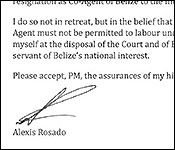
Notably, attached to today's release is a copy of Rosado's letter of resignation, which he sent to the Prime Minister.
In it, he says, quote, "There is presently ongoing in the public media an active and very public campaign of calumny against me, designed to tarnish my reputation by reference to allegations of wrongdoing wholly unrelated to my duties as Co-Agent of Belize before the International Court of Justice. I look forward to defending those allegations in court, where they properly belong and where, I am confident, their emptiness will be exposed. The vitriol of that media campaign, however, has now begun to be directed not only at me but at the Government and, more particularly, at my Office-the Office of the Agent. It is one thing for a public servant to bear the slings and arrows of a hostile press; it is another for the Office itself, and the cause it serves, to be made the collateral victim of a campaign whose logic is animus rather than evidence. I have therefore concluded, with profound regret but with settled conviction, that the interests of the Office of the Agent-and of Belize-are best served by my stepping aside."
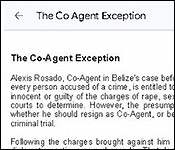
And perhaps the greatest accelerant speeding Rosado's demise was the extraordinary statement posted on Saturday by Speaker of the House Valerie Woods.
In an Instagram post captioned The Co-Agent Exception, Speaker of the House Valerie Woods broke ranks with her party to make a lucid and courageous declaration on what she considers to be the untenability and unsuitability of Ambassador Alexis Rosado's continued role as Belize's Co-Agent before the ICJ.
She writes of Rosado, "claims that he is indispensable or is critical to the success of the case seem exaggerated."
She questions, quote, "whether the high-profile title is being used as a kind of unspoken influence."
She grimly concludes, "The message to anyone who is observing is that Mr. Rosado is an extremely important person in the eyes of the state and exceptions should be made for him."
Almost speaking to directly rebut statements by the PM and the Foreign Minister, she says, "It cannot be the position that if Mr. Rosado is no longer Co-Agent then Belize's case is placed in jeopardy. Peddling such a narrative is misleading and the question has to be asked, why?"
She warns, quote, "Retaining him puts a reputational burden on the Office of the Agent and on Belize by extension."
Speaking of the 2022 national parliamentary Domestic Violence in Belize Motion, the annual 16 Days of Activism to End Gender-Based Violence-which was observed in the House-and other zero-tolerance initiatives by government, she concludes:
"Keeping Mr. Rosado in this high-profile position while he faces serious criminal charges involving rape and sexual assault questions Belize's commitment to these obligations. It sends troubling messages, particularly to women and girls, that high-ranking, powerful men are protected, they matter more, they are shielded from institutional consequences. This perception is damaging, regardless of the outcome of the criminal proceedings."
And mentioning that which no man in power has done, she looks to the victim and says, "For the complainant,this must be an unconscionable form of gaslighting that is unfolding publicly and compounding the distress of the proceedings."
The impact has resonated across the internet this weekend-with most commending Woods.
But in making this declaration, she is going against the declared positions of Prime Minister John Briceño and Foreign Minister Francis Fonseca.
For Woods, it is not the first time along that stony and solitary path.
In 2019, as Senator-when her party said no to the ICJ-similarly, she made a Facebook post supporting a yes vote. And when the matter came to the Senate, she again broke ranks and abstained, knowing the likely consequence:
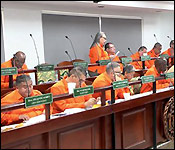
Valerie Woods, PUP Senator (Archival: April 2019) "I swear to bear true faith to Belize, allegiant to Belize in discharging my duty as a Senator on my... a vote of such an overarching national issue. My decision cannot be influenced for selfish reasons. I cannot be a selfish one, influenced by that notion of self-preservation. The interest of Belize is paramount. It should be for all of us. So, given the approach I take, I have to always finely balance, Mr. President... it has to be finely balanced with respect to the party that appointed me and that has afforded me the position to serve the country, with the dictates of principle and my conscience. Balancing those interests for country, party, and guided by my conscience, I am compelled to abstain on today's voting. And if it should be my swan song, Mr.President, I am comforted that it should be on an issue of existential importance to this country. So, if my head will be rolled, let it roll on this most critical national issue. And let the chips fall where they may."
Four months later, she was sacked from the Senate-but this time, she's House Speaker, and with all the public clamor for Rosado's removal, it would not be so easy to get rid of her, and PM Briceno has to tread carefully.
That report was compiled earlier this afternoon-before the Prime Minister took the decision to release Rosado.
The Belize Network of NGOs also joined the Speaker in a statement today, saying, quote, "The BNN aligns with the current call for Alexis Rosado to step down as Belize's Co-Agent in Belize's case before the International Court of Justice. This is not about prejudging guilt or innocence; it is about upholding the standards of conduct and accountability that the public has a reasonable expectation and right to expect from those entrusted with public responsibilities."
And along with BNN, several Ministers have declared their public position on the polarizing subject. Today the press spoke with PUP party chairman and Minister of Public Service Henry Charles Usher, who confirmed that a public officer would be put on interdiction in these matters and something similar should be done for Rosado:
Henry Charles Usher, Minister of Public Service "You know, I read the statement made by the Speaker of the House, and I support her statement. Number one, I think that not enough is done, even by the media, to show support for victims of these, you know, whatever the issue might be. But sometimes we don't have that victim support in our country.These cases tend to be sensationalized, and it does create an undue burden and probably a lot of trauma for the victim. So, it's important that we always keep the victim, the virtual complainant, in our thought process whenever decisions are made."
"When it comes to the individual, well, if he was a public officer, the regulations state very clearly that while this process is ongoing, that he'd be put on interdiction. So, I think that although he doesn't fall under the regulations because he's not a Section 106 public officer, that's something similar that could be done."
Reporter: "Do you hold the view that he holds an important value to this case as the Prime Minister and the Minister of Foreign Affairs, so much so that he cannot be removed?"
Henry Charles Usher: "Well, number one, of course, he is entitled to a fair trial. That's number one. Number two, he has contributed... I understand from the co-agents that he has contributed significantly to the case. But as I said, if the procedure is going to be followed, then it needs to be followed. And in life, nobody is indispensable, you know. We have to be able to make the most when a situation comes up and to make sure that there's somebody else that can do the work."
Again, this evening at 5:35 p.m., it was announced that Rosado had preempted all that and resigned as co-agent before the ICJ.
And turning now to police news, last week we told you about an alleged fuel card scandal within the Police Department. It involves a foursome of government fuel cards assigned to police vehicles but used to gas up commercial buses-a hustle where the bus owners got cheap fuel, the police fixer pocketed the proceeds of the illegal sales, and the gas station staff also got a cut. Reports say it went on for three years.
After an intensive police investigation, tonight we can tell you that the alleged ringleader, PC Roberto Hoare,has been charged with theft.
He was arraigned in court today, but according to police, he may not be the only one that charges are levied on. ASP Stacy Smith explained that their investigation is leading them to persons outside of the department:
ASP Stacy Smith, Staff Officer, Belize Police Department "Police have formally arrested and charged Roberto Hoare, a Belizean police constable, for the crime of theft. The arrest follows an ongoing investigation which commenced on Tuesday, 20th October 2026, when police became aware of the attempted usage of a fuel card to refuel a passenger bus. Further investigation resulted in the discovery that almost 1,800 gallons of fuel were disbursed under the fuel card for various vehicles, and the vehicle that was assigned to that particular fuel card was out of commission since March of 2026. As a consequence of this discovery, Mr. Hoare, who operates as the fleet manager in the Precinct 4 jurisdiction, was arrested and charged."
Reporter: "Will anybody else be charged for this crime? Others had to have been involved. Have they been cooperating with police and maybe struck a deal?"
ASP Stacy Smith: "What I will say is that it is an ongoing investigation. It is an investigation that has even taken us outside of the department, and certainly as more information is learned and it becomes necessary to be shared, that will be done. But suffice to say, the system that is in place is one that leaves an electronic footprint at each step of the way."
And PC Hoare is currently out on bail after being arraigned on theft charges today in Belize City Magistrate's Court. As you heard, he is accused of using the Police Department's fuel card for 1,800 gallons of fuel, which totaled over $25,000. Hoare was represented by attorney David McKoy and entered a plea of not guilty.
After the arraignment, McKoy spoke to Court Reporter Anita Nembhard:
David McKoy, Attorney "It's a strange case because Mr. Hoare is a fleet manager, and a fleet manager basically within the Police Department is an officer who is assigned to ensure that the different government vehicles that are assigned to the Police Department are fueled, and there are a lot of checks and balances that are in place.And so it is strange because of those circumstances, but I will leave it as strange at this time."
"These alleged theft occurred between March of 2026 to October of 2026, and the allegation is that the fuel card belonging to him was used in this process, and you heard from the facts that it did not say that he personally went to use this card to fuel for himself, so we'll see how it plays out in court."
"It's a sad situation when you see police officer being charged and have been dealt with in a way that it is not suitable, because everybody who has been charged, you expect they will go through some process at the court, at the police station. Nobody is above the law-not a police officer or anybody-so you'd expect that there's some stringent measures in place. But I would say this much: that courtesy goes a long way, and being courteous to someone, even though they are under immense pressure or detained, it still goes a long way,because police, from my understanding, was a brotherhood to some extent, and it doesn't seem that way now."
Hoare was granted bail of $4,000 plus one surety of the same amount. He will be back in court on January 13,2027.
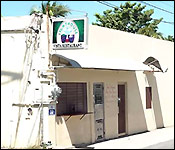
A 23-year-old man was killed this weekend in Ladyville in front of Vista Restaurant. Darrell Thompson was walking along Ocean Jack Avenue when someone in a black SUV fired upon him. ASP Smith gave us the details:
ASP Stacy Smith, Staff Officer, Belize Police Department "Police are investigating the murder of Darrell Thompson, a Belizean construction worker of Ladyville, which occurred on Friday, 23rd October 2026. The investigation commenced at approximately 10:45 p.m. when officers on patrol in Ladyville were alerted to the sounds of shots being fired in the vicinity of Ocean Jack Avenue in that community. What has been learnt so far in the course of this ongoing investigation is that Thompson along with two others were walking when an SUV approached and a male person exited and approached Mr. Thompson and fired several shots in his direction, which resulted in his fatal injury. No motive has been established so far; however, police have retrieved several video footage which are advancing the ongoing investigation."
Thompson's family told us they don't know why their son was targeted.
And that wasn't the only shooting this weekend. Last night, one centimeter more and it could have been murder-fortunately, it was not.
A child was grazed in her face while standing in a yard on Arlington Drive. Police suspect the intended target was one of the men near her in the same yard. Here's what ASP Smith told us:
ASP Stacy Smith, Staff Officer, Belize Police Department "Police are investigating a shooting incident which resulted in the injury of an 11-year-old female minor. The incident occurred on 25th October 2026, sometime after 8:01 p.m. on Arlington Drive, Belize City. Officers on patrol were alerted to the sounds of shots being fired, and upon their arrival at a location on Arlington Drive, they were advised that an injured female was taken to the hospital for medical attention. What we have learned so far in the course of the ongoing investigation is that the female minor along with four other persons were socializing at a property on Arlington Drive, when a male person approached and fired several shots in the direction of the group, resulting in the injury of the female minor. Two persons have since been detained, and police have retrieved several video footage which has assisted in the investigation. The minor has been treated and released from the hospital."
Reporter: "Do police know why they were shooting at that crowd of people?"
ASP Stacy Smith: "Two theories are being explored; however, it is too early to give a conclusive position on it."
Reporter: "And so police know which one of the persons were the intended target?"
ASP Stacy Smith: "We suspect one person to have been the intended target tied to the two theories that are being explored, but as I stated, we are not in a position to disclose that at this moment."
And while that child survived the shooting, a road traffic accident within Belize City limits has left one man dead. 28-year-old Karil Gentle was on a motorcycle last night on the Philip Goldson Highway when the fatal accident occurred. According to ASP Smith, he lost control of the motorcycle:
ASP Stacy Smith, Staff Officer, Belize Police Department "Police are investigating a traffic accident which resulted in the death of 28-year-old Karil Gentle of Belize City. What has been learnt so far in the course of the ongoing investigation is that on Sunday,25th of October 2026, at around 10:30 p.m., Gentle was traveling onboard a Lifan brand motorcycle from the direction of Ladyville to Belize City, and upon crossing a pedestrian ramp near Mile 4, he reportedly lost control of the motorcycle and collided into a lamppost. He was rushed to a hospital for medical attention; however, he succumbed to the injuries he sustained while undergoing treatment."
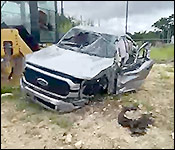
And another accident we have been reporting on since last night is one that occurred on October 2nd and totaled Minister Henry Charles Usher's ministerial ride.
According to Usher, they arrived late from San Ignacio when his driver dropped him off at home. After that, he says the driver suffered a blowout near the Fort George Roundabout-which is north of Usher's home.
The vehicle was totally wrecked, and the damage to the pickup does not seem consistent with just a blowout,but rather with losing control at high speed.
And it would have never come to the public's attention if we hadn't broken the story last week.
We asked ASP Smith whether the police investigated this case:
Reporter: "The car was wrecked, it was totaled. It doesn't seem consistent with a blowout. Have police been investigating, and what has the investigation shown so far?"
ASP Stacy Smith: "Yes, police have been investigating it. It's an ongoing investigation."
Reporter: "Was the vehicle insured?"
ASP Stacy Smith: "I believe so. It's not on the face of the report, but I would hope that given that it was a government vehicle, that the appropriate documentary requirements were along with it. What I will also say is that these government vehicles, they have systems in place that track if excessive speed was being used and all of that. So certainly we are conducting our investigation, because we know as the department as well that the Assets and Utilities section of the Ministry of Finance is always interested in finding out when government vehicles become the subject of damage, that if it is that anybody is at fault-which results in finance being lost through the replacement or repair of these vehicles-that those persons can be charged. So certainly the investigation is ongoing. As I stated, if it yields to any information of use, that will be made known to the public."
But when it comes to the RTA involving Usher's driver, how will the almost $100,000 value of the pickup be recovered?
According to Usher, when the accident happened, he reported it to Assets and Utilities Management immediately, but he was more concerned about his driver's safety. He spoke about road hazards:
Henry Charles Usher, Minister of Public Service "Anybody who traverses the highway, either regularly or occasionally, knows the hazards that are on our roads. So first and foremost, I'm happy that he's okay, and I'm thankful, grateful that nothing happened and no other vehicle was involved. His family... his family members are grateful that he is okay."
"When it comes to the incident, number one, I found out about it later. First thing I did was to check if he was okay. Number two, to make sure that a police report was made, which it was done. Because it is a government asset, it was turned over to the Assets and Utilities Management Unit and a report was made to them. The Ministry is now awaiting the response from that report."
"I wasn't present, so I wouldn't be able to comment on the details of what happened. But certainly, again, he is okay and the report was made to Assets and Utilities."
Reporter: "This is a pretty expensive public asset. Who foots the bill, Minister?"
Henry Charles Usher: "Well, number one, the vehicle was purchased by Assets and Utilities. It was a pre-owned vehicle, second-hand vehicle, and it was assigned to the Ministry. So, you are right, it is a government asset and when the report comes back, whatever is the conclusion will be honored."
Reporter: "In terms of... there may be instances where you may have to, or your driver may have to compensate, you're saying?"
Henry Charles Usher: "Well, there is a procedure for persons who damage government assets-whatever those government assets are. It could be computers, it could be furniture, AC units, whatever it is, there is a procedure that goes through. This is not the first vehicle that has gone to Assets and Utilities, and the procedure is followed. Every 'i' is dotted, every 't' is crossed, and we make sure that when the report comes back, it is honored."
Reporter: "In the meantime, has a new vehicle been assigned to you?"
Henry Charles Usher: "No, sir. No, sir."
Reporter: "So, how are you getting around?"
Henry Charles Usher: "Well, the Ministry has other vehicles assigned to it, so that's how I get to my official duties right now."
Reporter: "So, another vehicle has been assigned to you?"
Henry Charles Usher: "No, no, no. It's vehicles that have been assigned to the Ministry. So, it's just kind of trying to get them to take me around to the different events."
Usher has not officially been assigned a new vehicle.
And another accident occurred over the weekend, one that was caught on camera. Businessman Said Perdomo released this footage showing a vehicle ramming into his gate at high speeds on Friday night around 10:30 p.m. The vehicle and gate ended up in the exact location where Perdomo and his son were the night before, emphasizing how deadly it could have been.
While police have levied charges, they stated that up to this afternoon a report had not been made:
ASP Stacy Smith, Staff Officer, Belize Police Department "As it relates to the video pertaining to Mr. Perdomo's residence, what I can say is that the Police Department is not in possession of any report; however, we are aware of the video and it is my belief that the officers are taking necessary inquiry. Because certainly if it's not because of a medical condition or a vehicular manufacture failure or something to that sort, it would point to some sort of driving that is not conducive to other persons or other vehicles that are on the road. So certainly the investigation is expected to be carried out in that regard, but as it relates to whether any official report has been made, up to about an hour ago or so when I checked, no formal report was made to police."
However, this evening police issued a report stating that 32-year-old Veida Gomez, a paralegal, was driving the vehicle, which caused almost $40,000 in damages to Perdomo's property.
Gomez was detained and served with a summons to appear in Magistrate's Court on Thursday, October 29th,for failure to provide a specimen.
A student at Julian Cho High School is currently serving a suspension after he reportedly pulled out an airgun at his teacher in the middle of class. The incident occurred on October 20th, but according to ASP Smith, a formal report has not yet been made. She told us what the police know so far:
ASP Stacy Smith, Staff Officer, Belize Police Department "I can confirm that the Community Policing Unit in Punta Gorda are investigating an incident whereby it is alleged that upon a teacher making an inquiry of a student for his homework, and when that student was not able to give up his homework, the teacher asked for the demerit card and the student is alleged to have gone into his pants waist and pulled out an imitation firearm and placed it back into his pants waist. Eventually, with the encouragement of his classmates, the student handed over the imitation firearm. As of now, no formal report has been made by the teacher who is the subject of this incident. As stated, the Community Policing Unit has gotten involved, and as further developments are made, the media will be advised."
"There is an offense to have in your possession an imitation firearm with criminal intent, and as it relates to the student, the student is 16 years of age, which is the same age for criminal liability. But as I stated, no formal report has been given and we are continuing to address the situation based on information that is with police."
There was a new plane on the tarmac at the PGIA today. Bermudair has commenced seasonal operations in Belize today with additional flights to come in December.
The inaugural flight came in from Florida this afternoon, and Jaleeza Roberts was there when it landed:
Fresh off the Bermudair charter flight into Belize, passengers were greeted at the PGIA by drumming and light refreshments provided by the Belize tourism Board.
It was a celebration to commemorate the new commercial airline's dizzying schedule of direct flights from 4 different US destinations to Belize starting in December.
Andrea Spiegel, Chief Marketing & Communications, BERMUDAIR "We are thrilled to be here we are doing some major expansion at the moment but Belize is kind of a crown gem of that expansion. Today we launched Fort Lauderdale three times a week, Monday, Wednesday, Friday and in December we will be expanding to Boston, Raleigh Durham and two other Florida markets, Orlando Stanford and Tampa St Pete."
"We are seeing tremendous acceptance of our flights both originating here and originating in Fort Lauderdale and the other markets which are also the stands now so we are thrilled with the reception we are seeing so far and we hope that continues."
The Embraer 175 jet is known for regional and short- to medium-haul commercial flights,
Nicole Usher, CEO, Ministry of Tourism "Okay so the aircraft capacity I think is about 75 seats more or less and they probably came in with a load factor of maybe around 50% I would think for the first flight and they have indicated that that is very good for their inaugural flight."
Bermudair's partnership arrives to coincide with Belize's tourism high season, one that CEO for tourism Nicole Usher says they have high hopes for, when they hope to see an increase in arrivals.
Nicole Usher, CEO, Ministry of Tourism "Well we have an aviation development committee so there is routine regular communication with their airlines trying to present businesses cases for Belize to see where we can get new routes and which partners are best for Belize so this is one of the outcomes of those discussions and I think you may have seen last week with what we were doing in Frankfurt with the new flight from Europe this is similar to that there are ongoing discussions on a regular basis with many different airlines to try and see what we can do to develop new routes so this is one successful example so we are really happy and very proud of that."
And the added airlift is sorely needed by an industry which saw an 8.4% downturn in tourism arrivals between June and September. But even with a new flight operating, it will take a strong high season to get the numbers fully back on track.
According to the President of the Belize Hotel Association, some operators felt it more than others depending on their marketing pitch:
Jaleeza Roberts: "We have seen June, July, August, and September showing a downturn in arrivals. How has it affected your operation and your employees?"
Reynaldo Malik, President, Belize Hotel Association "Well, it's a mixed bag, really, because it really depends on who you're talking to in the industry. The larger players who have the marketing machinery that keeps getting fed, right, and our marketing constantly and consistently... while they may have seen a bit of a downturn, they were not going to have seen the same amount of downturn that the national average is suggesting, right? So you are going to talk to some people who said, 'I actually felt it more than the national average.' You know, the third quarter numbers are looking at an 8% decrease year-over-year. You're going to talk to people that have seen a bigger decrease than that, and you're going to talk to people like, for instance, at my group, at the Muyono Group, we've only seen a 1.5% decrease in that same period. So it's the law of averages, right? So it just depends on who you're talking to. The bigger players, like I said before, who have that marketing machinery that's constantly marketing and constantly innovating, they're not feeling the same crunch as those people that have a smaller marketing budget."
And now the overnight sector has 14 months to figure out how to market to European visitors.
For the first time, Belize has secured the commitment of a European airline for a direct flight.
Malik expressed excitement for the opening of this route:
Reynaldo Malik, President, Belize Hotel Association "It's a tremendous... to borrow a term, it's our white whale. We've been trying to spear that whale for decades, right? And so I've always believed that the first one in is going to be shortly followed by others shortly thereafter. And I think that one of the things that laid the groundwork for this-we can't undersell what happened to that... what was the cause, or what happened because of the flight from Montreal to Belize.Because what it showed airlines like Air Canada, they got a real feel for what the European appetite for Belize was, other than those who are already going to other places like Mexico and Guatemala. That flight from Montreal, I believe, provided the necessary data to cause Discover here to say, 'Okay, yeah, it's there. The business is there. Let's go do it now.'"
And as for the sargassum plague that wreaked havoc on our shores for most of this year, at last, that long national nightmare is receding-the sargassum flow is slowing down.
Malik gave us an update on the sargassum situation:
Reynaldo Malik, President, Belize Hotel Association "Well, it's a very timely occurrence that it's easing up a little bit. That's generally what happens this part of the year. The currents... mostly because of currents, change. We're starting to see a shift in winds and waves, for that matter, from starting to come more from the north. And that's going to start shifting a little bit more from northwesterly. So we tend to get more of that anytime from November going into the early part of the new year. So that in itself usually signals an easing up of the amount of sargassum that is going to inundate the actual beaches along the coastline."
But the damage is already done, and many hundreds of thousands of dollars have been spent on cleanups and disposal in an attempt to control the level of buildup on the beaches. We asked Malik how much the sargassum has hurt the tourism industry and arrivals:
Reporter: "How much did sargassum hurt arrivals this year?"
Reynaldo Malik: "Big time. The challenge with trying to put a value... it's tremendous, right? Because when you talk about the effect of sargassum on the Atlantic coast, and you're talking about everything from Cancún down to Tulum, Playa, all through Belize, through to Costa Rica. And if you look at the numbers for those particular destinations, Belize included, you will see all of us suffered a decline during that period, whereas some of the Caribbean territories who are more, I think, I believe it's leeward facing and don't necessarily have to suffer the effects of sargassum on their beaches, they actually trended better in the summer months this year. So it is certainly the biggest factor, I would say, in terms of overnight visits to Belize this year. But you also have to put that together with the cost of... the rising cost of flights to Belize, which is, you know, obviously why we're here today. We're hoping for some competition on the East Coast provided to our American Airlines,which will hopefully push down their prices and start making travel to Belize more affordable."
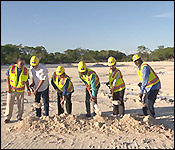
In other news, a new cattle corral is coming to the Corozal District with a project funded through the World Bank's Climate Resilient and Sustainable Agriculture Project.
It was launched on Friday in Corozal. Jaleeza Roberts reports:
This is the area where Belize's livestock industry is expected to take another step forward, as a new cattle export corral breaks ground in Chan Chen Village, Corozal District. The project comes as Belize's cattle population continues to grow, increasing from approximately 203,000 head in 2025 to 217,000 in 2026. At the groundbreaking ceremony, CEO in the Office of the Prime Minister Narda Garcia explained that this investment was critical:
Narda Garcia, CEO, Office of the Prime Minister "Belize's cattle industry continues to demonstrate its potential as a significant contributor to our agricultural economy. The Mexican market in particular remains a critical destination for our cattle producers with an export quota of 10,000 head of cattle. Belize has exported approximately 7,750 head to Mexico in 2025, generating a value of almost 16 million dollars. These figures tell a compelling story-they demonstrate the importance of this market and the opportunities available to Belizean farmers when the right infrastructure and the right support systems are in place. An investment of 3 million dollars in the construction of this facility and in strengthening the capacity of the Belize Livestock Producers Association is, therefore, an investment in the future of our livestock industry. When completed, this corral will serve as public infrastructure that brings cattle producers and buyers together in a more organized and efficient manner."
And the CEO in the Ministry of Agriculture says this is not only a win for them, but the farmers who continue to benefit from the market:
Servulo Baeza, CEO, Ministry of Agriculture "This facility will be a game changer for our northern ranchers. Strategically located near our northern border, this corral will act as a primary engine for the export value chain. By streamlining animal handling, optimizing weight retention, and providing a modern space for official inspection and quarantine, this infrastructure directly improves our global export readiness. It ensures that the cattle leaving our pastures can legally, safely, and efficiently reach lucrative regional markets such as Mexico, while commanding the premium prices our farmers rightfully deserve."
Minister of Agriculture Rodwell Ferguson pointed to the need to expand export opportunities beyond Mexico,where Belize has a target of exporting 10,000 head of cattle annually:
Rodwell Ferguson, Minister of Agriculture "I can see cattle becoming our number one industry, maybe a year or two from now,because most farmers across the country have the effects of citrus. We also have coconut and rice, so you can see a combination between coconut and cattle as we progress. But as I became the Minister of Agriculture, I recognized that if we expand our cattle industry, and Mexico is only taking 10,000 per year as we speak, then what are we going to do with the remainder of cattle? While there's an informal trade with Guatemala, they take about maybe 30,000 to 32,000 per year. We believe we can do much more, and about a week ago, I successfully negotiated with a team out of the United States, and they are now preparing to build a beef processing plant in the district of Orange Walk."
The corral's aim is to facilitate the movement of cattle from across Belize, supporting the long-term expansion of the livestock sector.
International and local healthcare professionals are meeting in Belize City for a landmark summit aimed at tackling some of the biggest issues facing the medical sector.
The California-based Monarchy Consulting Group is hosting the Inaugural International Medical Conference at the Biltmore Hotel, bringing experts together under one roof to share insights, discuss modern industry challenges, and foster regional collaboration.
Jaleeza Roberts was at the opening session today and brings us this report:
Health Minister Responds to Media Coverage on Leaked CABEI KHMH Report
Last week we told you about the leaked CABEI report on the woeful condition of the KHMH, which experts detailed when they made an assessment in 2024.
On Friday the 16th, we showed you how Health Minister Kevin Bernard flip-flopped on the issue between 2024 and 2026.
Today, he said we're playing funny games:
Kevin Bernard, Minister of Health & Wellness "I think, you know, I smiled after I gave that response. I think sometimes the media tries to play some funny games, because I recall very well when I gave that initial interview back... I had spoken to the then-CEO Ms. Sandra Cansino, who had briefly responded, but I will stay with exactly what I have said: I have not seen the report personally until just recently. And so while I was given some information, and I stick to that. The issue of the Karl Heusner Memorial Hospital, everybody understand that while the facility is an old facility the Government of Belize has already been discussing ideas and ways on how we are... are going to address the issue-if possible, a new facility, but that will provide secondary care while we look at how we can strengthen KHMH to be able to provide the tertiary care level. Of course, the infrastructure, the physical infrastructure of KHMH needs to be looked at, and so it is not about just saying we are going to knock down KHMH and build a new tertiary level. That is the reason the foresight was that we build a tertiary level facility in Belmopan while we work on a new secondary care facility in Belize City, and hopefully that we continue to expand and work on a better tertiary level facility that KHMH provides. So at the end of the day, it is long-term vision, it is long-term planning, we have to look at all of these things."
Health Minister Considers Locations for New Secondary Care Hospital in Belize District
But Bernard maintains and insists that KHMH won't be an easy fix and that the repairs will cost just as much as a new hospital. He shared the locations they have been considering for building a new main hospital for the Belize District:
Kevin Bernard, Minister of Health & Wellness "And so while the report, yes, highlighted in 2024 the issues, I think the report clearly stated it is best to build a new facility as opposed to renovate a facility that would have cost you more. So government has to look at those options, and that is where the idea came up that there is a possible plan through CABEI research that a new secondary facility be built in Belize City. And I think we were also toying on the idea that we may want to look at a land on Chetumal Boulevard or all of these things closer to where the Ministry of Finance building is or Eleanor Hall. I don't recall the full details, but I know that they were looking at areas that we could possibly build a new hospital for Belize District."
Minister Kevin Bernard Remembers Businessman and Political Associate Renan Briceno Sr.
In other news, businessman and first cousin to Prime Minister John Briceno, Renan Briceno Sr., passed away on Sunday afternoon after a long battle with cancer.
His friend and political associate, Orange Walk East Area Representative Kevin Bernard, had worked with Briceño for several years. Today he shared his memories of Briceño following his passing:
Kevin Bernard, Minister of Health & Wellness "Renan and I share a very personal friendship. I think everybody knows Renan-as we famously call him 'Shao' in Orange Walk, he was a very humble guy. Renan, when I started politics, he was the one who said, 'Kev, we got to go all the way,' and he supported me in my mayorship, supported me when I ran as a counselor, and has been supportive of me as a brother in my late... up to national government. And so I want to extend my deepest condolences to the Briceño family, to his family: Ms. Maudi, Estelita, and Rancho, and all of them, Natasha, and the entire Briceño family on the passing of Renan. He was an icon in Orange Walk, a well-known individual, like I said, a very, very loving individual. I know the amount of people he has assisted and supported... was never a man who asked for anything in return, and so Renan will be deeply missed in our community, and of course tremendously missed in the political work that we do as a party in Orange Walk, because he was very, very instrumental in carrying out the work we do. I know he worked closely in Orange Walk Central, but from when I was mayor as a town, we worked very closely. But again, from a personal standpoint, he was a great friend, family, but... but somebody who worked with his community and helped his community one way or another. Silently, but always there for the people."
PUP Chairman Henry Charles Usher Pays Tribute to PUP Loyalist Renan Briceno Sr.
Latterly, Briceno Sr. was known as a karaoke enthusiast and part-owner of the Briceno shares in Speednet.
Today, PUP Chairman Henry Charles Usher put his passing in the context of a loss for the party:
Henry Charles Usher: "Another big loss for the party, Mr. Renan Briceno, cousin of the Prime Minister, passed yesterday, and certainly I want to express condolences to the Briceño family. I have reached out to them. I reached out to his son to express my condolences, to just explain how Renan was such an integral part of the north, of Orange Walk, of all of the work that Prime Minister Briceño has been doing. They worked very closely for a long period of time as business partners, as political partners, and Renan offered a lot of advice and guidance to the party as well, so he will be greatly missed."








 Email
Email Print
Print

 Tonight, Belize's Co-Agent before the ICJ, Alexis Rosado, has been forced to resign. This comes after public pressure reached a breaking point this weekend, particularly after Speaker of the House Valerie Woods weighed in mightily against Rosado.

 And perhaps the greatest accelerant speeding Rosado's demise was the extraordinary statement posted on Saturday by Speaker of the House Valerie Woods.
 Valerie Woods, PUP Senator (Archival: April 2019)
 The Belize Network of NGOs also joined the Speaker in a statement today, saying, quote, "The BNN aligns with the current call for Alexis Rosado to step down as Belize's Co-Agent in Belize's case before the International Court of Justice. This is not about prejudging guilt or innocence; it is about upholding the standards of conduct and accountability that the public has a reasonable expectation and right to expect from those entrusted with public responsibilities."
 "You know, I read the statement made by the Speaker of the House, and I support her statement. Number one, I think that not enough is done, even by the media, to show support for victims of these, you know, whatever the issue might be. But sometimes we don't have that victim support in our country.These cases tend to be sensationalized, and it does create an undue burden and probably a lot of trauma for the victim. So, it's important that we always keep the victim, the virtual complainant, in our thought process whenever decisions are made."

 And turning now to police news, last week we told you about an alleged fuel card scandal within the Police Department. It involves a foursome of government fuel cards assigned to police vehicles but used to gas up commercial buses-a hustle where the bus owners got cheap fuel, the police fixer pocketed the proceeds of the illegal sales, and the gas station staff also got a cut. Reports say it went on for three years.
 "Police have formally arrested and charged Roberto Hoare, a Belizean police constable, for the crime of theft. The arrest follows an ongoing investigation which commenced on Tuesday, 20th October 2026, when police became aware of the attempted usage of a fuel card to refuel a passenger bus. Further investigation resulted in the discovery that almost 1,800 gallons of fuel were disbursed under the fuel card for various vehicles, and the vehicle that was assigned to that particular fuel card was out of commission since March of 2026. As a consequence of this discovery, Mr. Hoare, who operates as the fleet manager in the Precinct 4 jurisdiction, was arrested and charged."
 David McKoy, Attorney
 A 23-year-old man was killed this weekend in Ladyville in front of Vista Restaurant. Darrell Thompson was walking along Ocean Jack Avenue when someone in a black SUV fired upon him. ASP Smith gave us the details:
 And another accident we have been reporting on since last night is one that occurred on October 2nd and totaled Minister Henry Charles Usher's ministerial ride.
 There was a new plane on the tarmac at the PGIA today. Bermudair has commenced seasonal operations in Belize today with additional flights to come in December.
 "We are thrilled to be here we are doing some major expansion at the moment but Belize is kind of a crown gem of that expansion. Today we launched Fort Lauderdale three times a week, Monday, Wednesday, Friday and in December we will be expanding to Boston, Raleigh Durham and two other Florida markets, Orlando Stanford and Tampa St Pete."
 Bermudair's partnership arrives to coincide with Belize's tourism high season, one that CEO for tourism Nicole Usher says they have high hopes for, when they hope to see an increase in arrivals.
 Reynaldo Malik, President, Belize Hotel Association
 In other news, a new cattle corral is coming to the Corozal District with a project funded through the World Bank's Climate Resilient and Sustainable Agriculture Project.
 "Belize's cattle industry continues to demonstrate its potential as a significant contributor to our agricultural economy. The Mexican market in particular remains a critical destination for our cattle producers with an export quota of 10,000 head of cattle. Belize has exported approximately 7,750 head to Mexico in 2025, generating a value of almost 16 million dollars. These figures tell a compelling story-they demonstrate the importance of this market and the opportunities available to Belizean farmers when the right infrastructure and the right support systems are in place. An investment of 3 million dollars in the construction of this facility and in strengthening the capacity of the Belize Livestock Producers Association is, therefore, an investment in the future of our livestock industry. When completed, this corral will serve as public infrastructure that brings cattle producers and buyers together in a more organized and efficient manner."
 "This facility will be a game changer for our northern ranchers. Strategically located near our northern border, this corral will act as a primary engine for the export value chain. By streamlining animal handling, optimizing weight retention, and providing a modern space for official inspection and quarantine, this infrastructure directly improves our global export readiness. It ensures that the cattle leaving our pastures can legally, safely, and efficiently reach lucrative regional markets such as Mexico, while commanding the premium prices our farmers rightfully deserve."
 "I can see cattle becoming our number one industry, maybe a year or two from now,because most farmers across the country have the effects of citrus. We also have coconut and rice, so you can see a combination between coconut and cattle as we progress. But as I became the Minister of Agriculture, I recognized that if we expand our cattle industry, and Mexico is only taking 10,000 per year as we speak, then what are we going to do with the remainder of cattle? While there's an informal trade with Guatemala, they take about maybe 30,000 to 32,000 per year. We believe we can do much more, and about a week ago, I successfully negotiated with a team out of the United States, and they are now preparing to build a beef processing plant in the district of Orange Walk."
 Last week we told you about the leaked CABEI report on the woeful condition of the KHMH, which experts detailed when they made an assessment in 2024.
 Kevin Bernard, Minister of Health & Wellness
 In other news, businessman and first cousin to Prime Minister John Briceno, Renan Briceno Sr., passed away on Sunday afternoon after a long battle with cancer.
